Irish Independent review ‘Ruby’
Nuanced, messy and complicated: ‘The Truth About Ruby Cooper' shows Liz Nugent at the top of her game
Saturday 14th March 2026
Article by Darragh McManus
Darragh McManus' books include ‘The Driving Force' and ‘Pretend We're Dead'
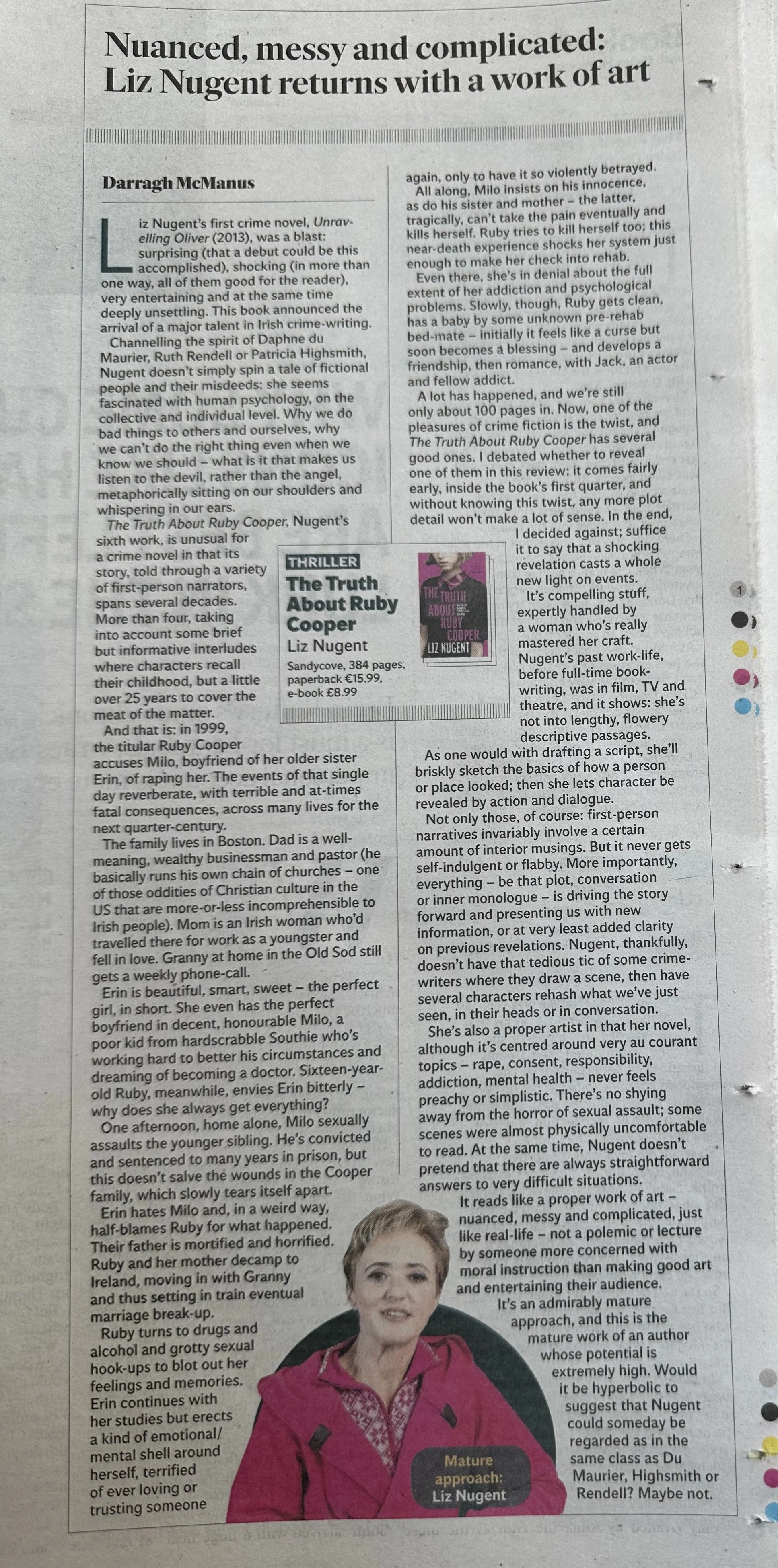
Thriller: The Truth About Ruby Cooper by Liz Nugent
Sandycove, 384 pages, paperback €15.99, e-book £8.99
Liz Nugent's first crime novel, Unravelling Oliver (2013), was a blast: surprising (that a debut could be this accomplished), shocking (in more than one way, all of them good for the reader), very entertaining and at the same time deeply unsettling. This book announced the arrival of a major talent in Irish crime-writing.
Channelling the spirit of Daphne du Maurier, Ruth Rendell or Patricia Highsmith, Nugent doesn't simply spin a tale of fictional people and their misdeeds: she seems fascinated with human psychology, on the collective and individual level. Why we do bad things to others and ourselves, why we can't do the right thing even when we know we should - what is it that makes us listen to the devil, rather than the angel, metaphorically sitting on our shoulders and whispering in our ears.
The Truth About Ruby Cooper, Nugent's sixth work, is unusual for a crime novel in that its story, told through a variety of first-person narrators, spans several decades.
More than four, taking into account some brief but informative interludes where characters recall their childhood, but a little over 25 years to cover the meat of the matter.
And that is: in 1999, the titular Ruby Cooper
accuses Milo, boyfriend of her older sister Erin, of raping her. The events of that single day reverberate, with terrible and at-times fatal consequences, across many lives for the next quarter-century.
The family lives in Boston. Dad is a well-meaning, wealthy businessman and pastor (he basically runs his own chain of churches - one of those oddities of Christian culture in the US that are more-or-less incomprehensible to Irish people.) Mom is an Irish woman who'd travelled there for work as a youngster and fell in love. Granny at home in the Old Sod still gets a weekly phone call.
Erin is beautiful, smart, sweet - the perfect girl, in short. She even has the perfect boyfriend in decent, honourable Milo, a poor kid from hardscrabble Southie who's working hard to better his circumstances and dreaming of becoming a doctor. Sixteen-year-old Ruby, meanwhile, envies Erin bitterly - why does she always get everything?
One afternoon, home alone, Milo sexually assaults the younger sibling. He's convicted and sentenced to many years in prison, but this doesn't salve the wounds in the Cooper family, which slowly tears itself apart.
Erin hates Milo and, in a weird way, half-blames Ruby for what happened.
Their father is mortified and horrified.
Ruby and her mother decamp to Ireland, moving in with Granny and thus setting in train eventual marriage break-up.
Ruby turns to drugs and alcohol and grotty sexual hook-ups to blot out her feelings and memories.
Erin continues with her studies but erects a kind of emotional/ mental shell around herself, terrified of ever loving or trusting someone
again, only to have it so violently betrayed.
All along, Milo insists on his innocence, as do his sister and mother - the latter, tragically, can't take the pain eventually and kills herself. Ruby tries to kill herself too; this near-death experience shocks her system just enough to make her check into rehab.
Even there, she's in denial about the full extent of her addiction and psychological problems. Slowly, though, Ruby gets clean, has a baby by some unknown pre-rehab bed-mate - initially it feels like a curse but soon becomes a blessing - and develops a friendship, then romance, with Jack, an actor and fellow addict.
A lot has happened, and we're still only about 100 pages in. Now, one of the pleasures of crime fiction is the twist, and The Truth About Ruby Cooper has several good ones. I debated whether to reveal one of them in this review: it comes fairly early, inside the book's first quarter, and without knowing this twist, any more plot detail won't make a lot of sense. In the end,
I decided against; suffice it to say that a shocking revelation casts a whole new light on events.
It's compelling stuff, expertly handled by a woman who's really mastered her craft.
Nugent's past work-life, before full-time book-writing, was in film, TV and theatre, and it shows: she's not into lengthy, flowery descriptive passages.
As one would with drafting a script, she'll briskly sketch the basics of how a person or place looked; then she lets character be revealed by action and dialogue.
Not only those, of course: first-person narratives invariably involve a certain amount of interior musings. But it never gets self-indulgent or flabby. More importantly, everything - be that plot, conversation or inner monologue - is driving the story forward and presenting us with new information, or at very least added clarity on previous revelations. Nugent, thankfully, doesn't have that tedious tic of some crime-writers where they draw a scene, then have several characters rehash what we’ve just seen, in their heads or in conversation.
She's also a proper artist in that her novel, although it's centred around very au courant topics - rape, consent, responsibility, addiction, mental health - never feels preachy or simplistic. There's no shying away from the horror of sexual assault; some scenes were almost physically uncomfortable to read. At the same time, Nugent doesn't pretend that there are always straightforward answers to very difficult situations.
It reads like a proper work of art - nuanced, messy and complicated, just like real-life - not a polemic or lecture by someone more concerned with moral instruction than making good art and entertaining their audience.
It's an admirably mature approach, and this is the mature work of an author whose potential is extremely high. Would it be hyperbolic to suggest that Nugent could some day be regarded as in the same class as Du Maurier, Highsmith or Rendell? Maybe not.