Sunday Independent feature article
‘Family ties: Novelist Liz Nugent on growing up and deciding not to have children’
Sunday 15th March 2026
Article by Dónal Lynch
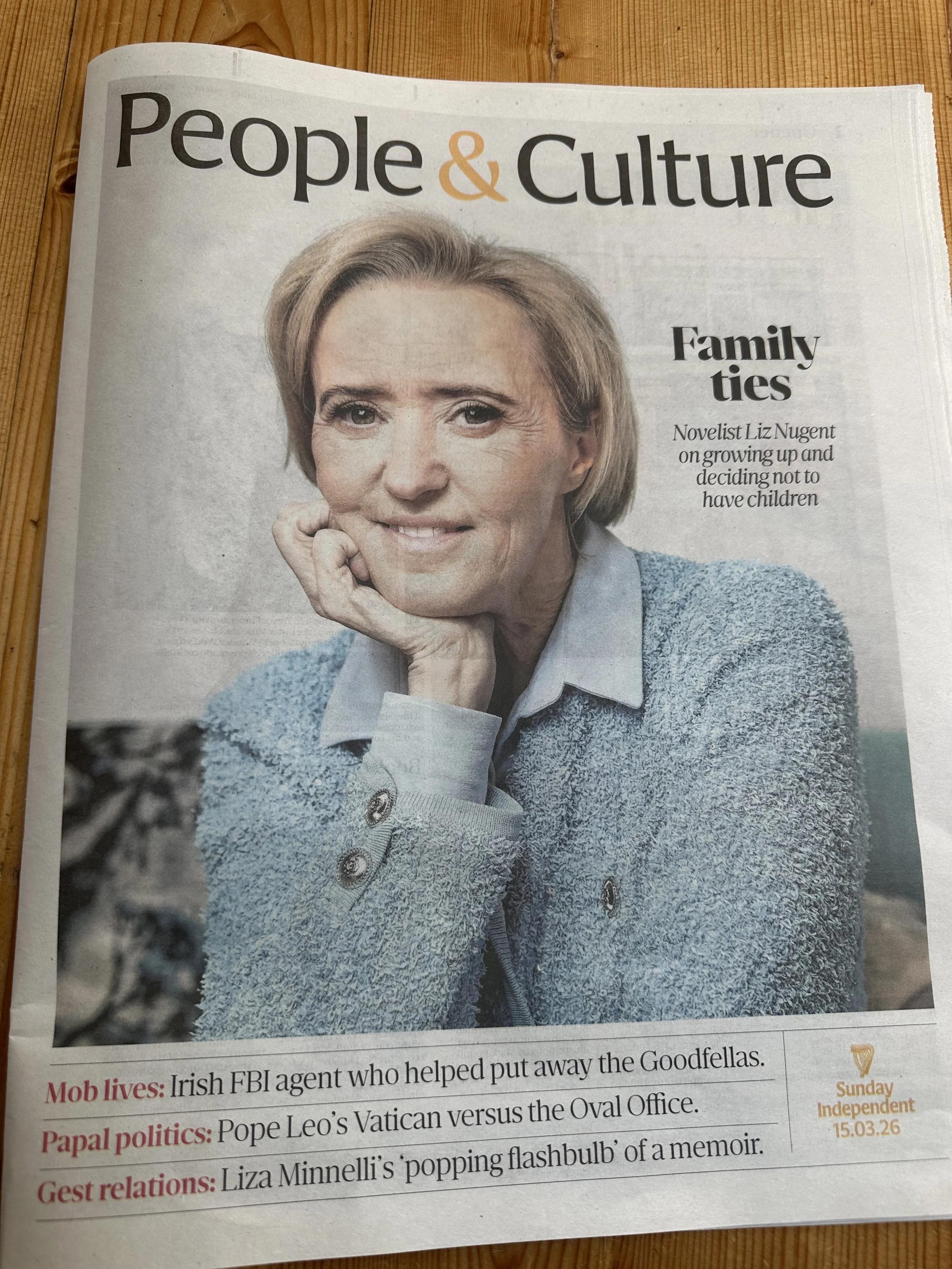
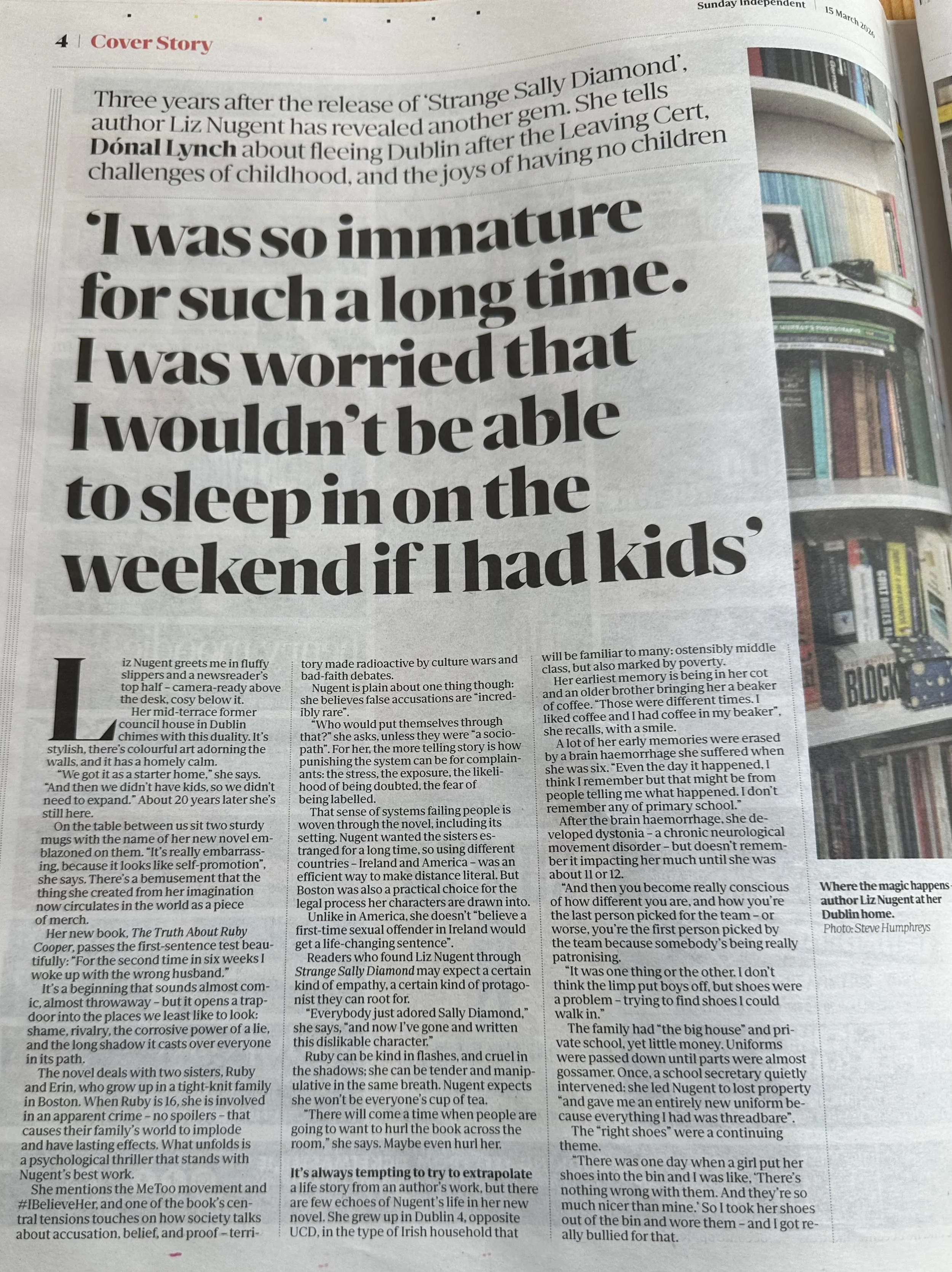
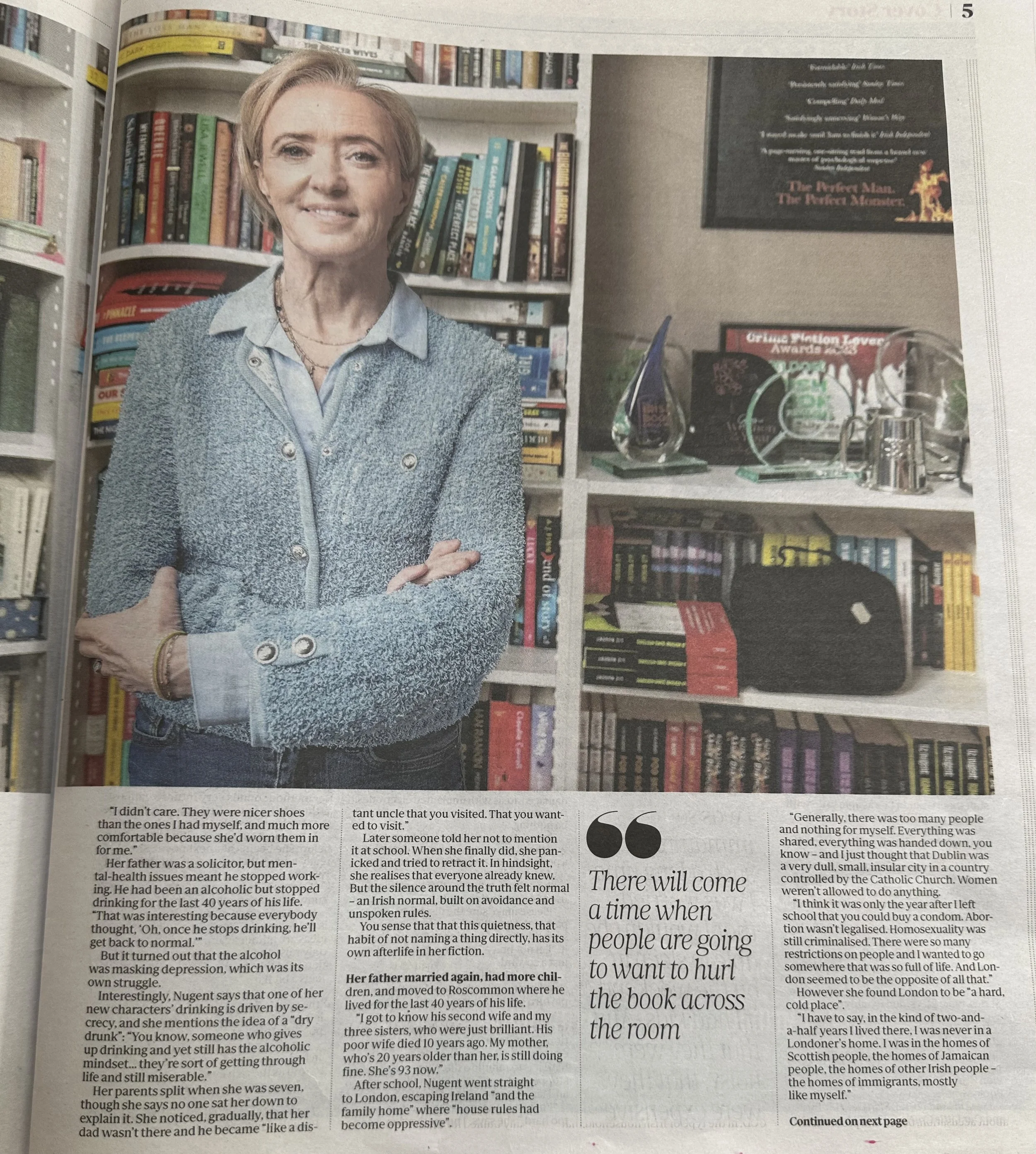
Liz Nugent greets me in fluffy slippers and a newsreader's top half, camera-ready above the desk, cosy below it.
Her mid-terrace former council house in Dublin chimes with this duality. It's stylish, there's colourful art adorning the walls, and it has a homely calm.
"We got it as a starter home," she says. "And then we didn't have kids, so we didn't need to expand." About 20 years later she's still here.
On the table between us sit two sturdy mugs with the name of her new novel emblazoned on them. "It's really embarrassing, because it looks like self-promotion", she says. There's a bemusement that the thing she created from her imagination now circulates in the world as a piece of merch.
Her new book, The Truth About Ruby Cooper, passes the first-sentence test beautifully: "For the second time in six weeks l woke up with the wrong husband." It's a beginning that sounds almost comic, almost throwaway - but it opens a trapdoor into the places we least like to look: shame, rivalry, the corrosive power of a lie, and the long shadow it casts over everyone in its path.
The novel deals with two sisters, Ruby and Erin, who grow up in a tight-knit family in Boston. When Ruby is 16, she is involved in an apparent crime - no spoilers- that causes their family's world to implode and have lasting effects. What unfolds is a psychological thriller that stands with Nugent's best work.
She mentions the MeToo movement and #IBelieveHer, and one of the book's central tensions touches on how society talks about accusation, belief, and proof - territory made radioactive by culture wars and bad-faith debates.
Nugent is plain about one thing though: she believes false accusations are "incredibly rare". “Who would put themselves through that?" she asks, unless they were "a sociopath". For her, the more telling story is how punishing the system can be for complainants: the stress, the exposure, the likelihood of being doubted, the fear of being labelled.
That sense of systems failing people is woven through the novel, including its setting. Nugent wanted the sisters estranged for a long time, so using different countries - Ireland and America - was an efficient way to make distance literal. But Boston was also a practical choice for the legal process her characters are drawn into.
Unlike in America, she doesn't "believe a first-time sexual offender in Ireland would get a life-changing sentence".
Readers who found Liz Nugent through Strange Sally Diamond may expect a certain kind of empathy, a certain kind of protagonist they can root for.
"Everybody just adored Sally Diamond," she says, "and now I've gone and written this dislikable character."
Ruby can be kind in flashes, and cruel in the shadows; she can be tender and manipulative in the same breath. Nugent expects she won't be everyone's cup of tea.
"There will come a time when people are going to want to hurl the book across the room," she says. Maybe even hurl her.
It's always tempting to try to extrapolate a life story from an author's work, but there are few echoes of Nugent's life in her new novel. She grew up in Dublin 4, opposite UCD, in the type of Irish household that will be familiar to many: ostensibly middle class, but also marked by poverty.
Her earliest memory is being in her cot and an older brother bringing her a beaker of coffee. "Those were different times. I liked coffee and I had coffee in my beaker". she recalls, with a smile.
A lot of her early memories were erased by a brain haemorrhage she suffered when she was six. "Even the day it happened, I think I remember but that might be from people telling me what happened. I don't remember any of primary school."
After the brain haemorrhage, she developed dystonia - a chronic neurological movement disorder - but doesn't remember it impacting her much until she was about 11 or 12.
"And then you become really conscious of how different you are, and how you're the last person picked for the team - or worse, you’re the first person picked for the team because somebody's being really patronising.
"It was one thing or the other. I don't think the limp put boys off, but shoes were a problem - trying to find shoes I could walk in."
The family had "the big house" and private school, yet little money. Uniforms were passed down until parts were almost gossamer. Once, a school secretary quietly intervened: she led Nugent to lost property "and gave me an entirely new uniform because everything I had was threadbare".
The "right shoes" were a continuing theme. “There was one day when a girl put her shoes into the bin and I was like, 'There's nothing wrong with them. And they re so much nicer than mine.’ So I took her shoes out of the bin and wore them - and I got really bullied for that.
“I didn't care. They were nicer shoes than the ones I had myself, and much more comfortable because she'd worn them in for me." Her father was a solicitor, but mental health issues meant he stopped working. He had been an alcoholic but stopped drinking for the last 40 years of his life.
“That was interesting because everybody thought, 'Oh, once he stops drinking, he'll get back to normal.’"
But it turned out that the alcohol was masking depression, which was its own struggle.
Interestingly, Nugent says that one of her new characters' drinking is driven by secrecy, and she mentions the idea of a "dry drunk”: "You know, someone who gives up drinking and yet still has the alcoholic mindset... they're sort of getting through life and still miserable."
Her parents split when she was seven, though she says no one sat her down to explain it. She noticed, gradually, that her dad wasn't there and he became “like a distant uncle that you visited. That you wanted to visit."
Later someone told her not to mention it at school. When she finally did, she panicked and tried to retract it. In hindsight, she realises that everyone already knew.
But the silence around the truth felt normal - an Irish normal, built on avoidance and unspoken rules.
You sense that that this quietness, that habit of not naming a thing directly, has its own afterlife in her fiction.
Her father married again, had more children, and moved to Roscommon where he lived for the last 40 years of his life.
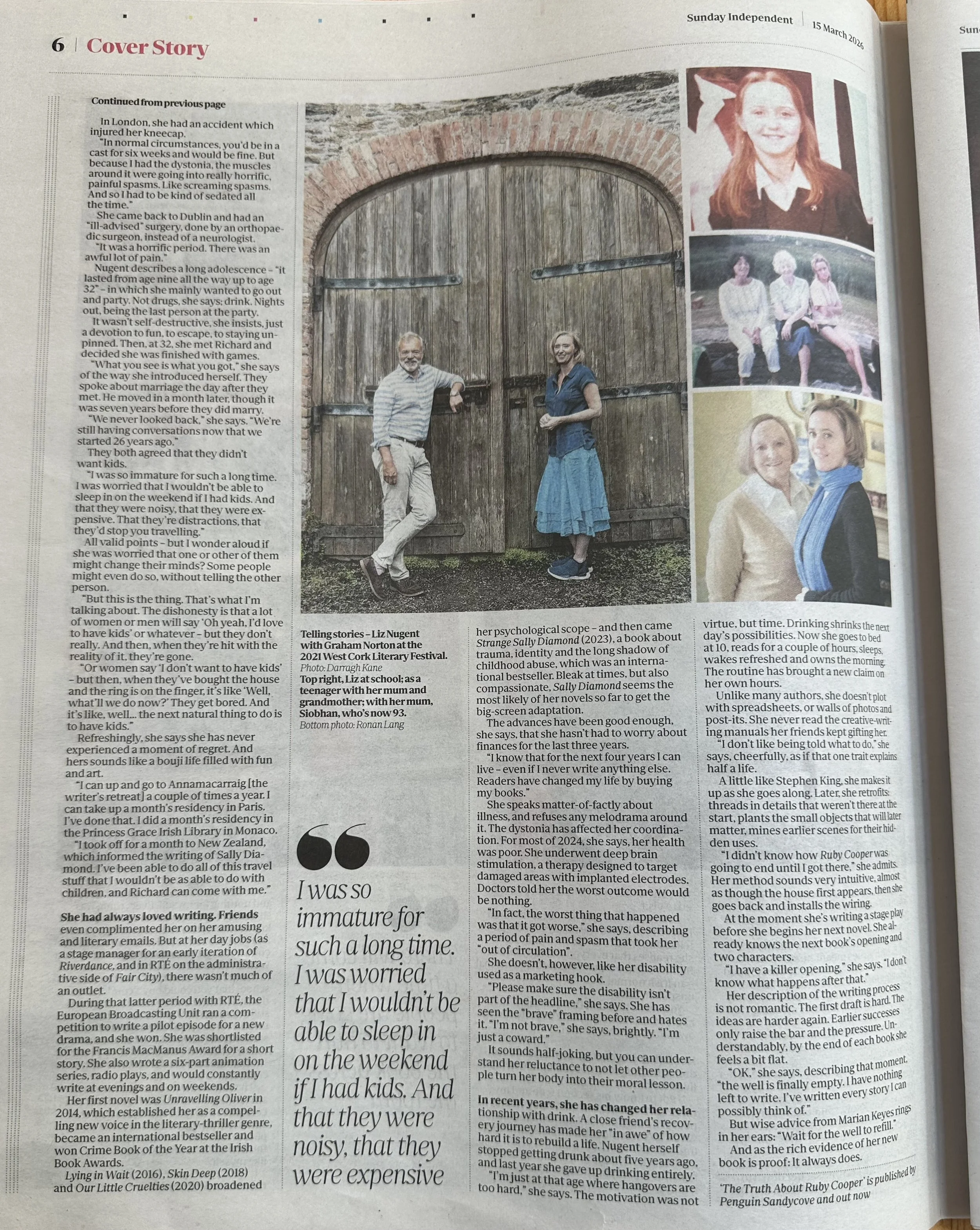
“I got to know his second wife and my three sisters, who were just brilliant. His poor wife died 10 years ago. My mother, who's 20 years older than her, is still doing fine. She's 93 now."
After school, Nugent went straight to London, escaping Ireland "and the family home" where "house rules had become oppressive". "Generally, there was too many people and nothing for myself. Everything was shared, everything was handed down, you know - and I just thought that Dublin was a very dull, small, insular city in a country controlled by the Catholic Church. Women weren't allowed to do anything.
”I think it was only the year after I left school that you could buy a condom. Abortion wasn't legalised. Homosexuality was still criminalised. There were so many restrictions on people and I wanted to go somewhere that was so full of life. And London seemed to be the opposite of all that." However she found London to be “a hard, cold place.”
” I have to say, in the kind of two-and-a-half years I lived there, I was never in a Londoner's home. I was in the homes of Scottish people, the homes of Jamaican people, the homes of other Irish people - the homes of immigrants, mostly like myself."
In London, she had an accident which injured her kneecap.
"In normal circumstances, you'd be in a cast for six weeks and would be fine. But because I had the dystonia, the muscles around it were going into really horrific. painful spasms. Like screaming spasms. And so I had to be kind of sedated all the time.”
She came back to Dublin and had an "ill-advised" surgery, done by an orthopaedic surgeon, instead of a neurologist.
“It was a horrific period. There was an awful lot of pain."
Nugent describes a long adolescence - "it lasted from age nine all the way up to age 32” - in which she mainly wanted to go out and party. Not drugs, she says: drink. Nights out, being the last person at the party.
“It wasn't self-destructive,” she insists, “just a devotion to fun, to escape, to staying unpinned.” Then, at 32, she met Richard and decided she was finished with games.
"What you see is what you got,” she says of the way she introduced herself. They spoke about marriage the day after they met. He moved in a month later, though it was seven years before they did marry.
“We never looked back," she says. "We're still having conversations now that we started 26 years ago."
They both agreed that they didn't want kids.
"I was so immature for such a long time. I was worried that I wouldn't be able to sleep in on the weekend if I had kids. And that they were noisy, that they were expensive. That they're distractions, that they'd stop you travelling."
All valid points - but I wonder aloud if she was worried that one or other of them might change their minds? Some people might even do so, without telling the other person.
"But this is the thing. That's what I'm talking about. The dishonesty is that a lot of women or men will say 'Oh yeah, I'd love to have kids' or whatever - but they don't really. And then, when they're hit with the reality of it, they're gone. Or women say ‘I don't want to have kids' - but then, when they've bought the house and the ring is on the finger, it's like ‘Well, what'll we do now?' They get bored. And it's like, well... the next natural thing to do is to have kids."
Refreshingly, she says she has never experienced a moment of regret. And hers sounds like a bouji life filled with fun and art.
“I can up and go to Annamacarraig (the writer's retreat) a couple of times a year. I can take up a month's residency in Paris. I've done that. I did a month's residency in the Princess Grace Irish Library in Monaco.
“I took off for a month to New Zealand, which informed the writing of Sally Diamond. I've been able to do all of this travel stuff that I wouldn't be as able to do with children, and Richard can come with me." She had always loved writing. Friends even complimented her on her amusing and literary emails. But at her day jobs (as a stage manager for an early iteration of Riverdance, and in RTE on the administrative side of Fair City), there wasn't much of an outlet.
During that latter period with RTÉ, the European Broadcasting Unit ran a competition to write a pilot episode for a new drama, and she won. She was shortlisted for the Francis MacManus Award for a short story. She also wrote a six-part animation series, radio plays, and would constantly write at evenings and on weekends.
Her first novel was Unravelling Oliver in 2014, which established her as a compelling new voice in the literary-thriller genre, became an international bestseller and won Crime Book of the Year at the Irish Book Awards.
Lying in Wait (2016), Skin Deep (2018) and Our Little Cruelties (2020) broadened her psychological scope - and then came Strange Sally Diamond (2023), a book about trauma, identity and the long shadow of childhood abuse, which was an international bestseller: Bleak at times, but also compassionate, Sally Diamond seems the most likely of her novels so far to get the big-screen adaptation.
The advances have been good enough, she says, that she hasn't had to worry about finances for the last three years.
“I know that for the next four years I can live - even if I never write anything else. Readers have changed my life by buying my books.”
She speaks matter-of-factly about illness, and refuses any melodrama around it. The dystonia has affected her coordination. For most of 2024, she says, her health was poor. She underwent deep brain stimulation, a therapy designed to target damaged areas with implanted electrodes.
Doctors told her the worst outcome would be nothing.
“In fact, the worst thing that happened was that it got worse," she says, describing a period of pain and spasm that took her "out of circulation".
She doesn't, however, like her disability used as a marketing hook.
"Please make sure the disability isn't part of the headline," she says. She has seen the "brave" framing before and hates it. "I'm not brave," she says, brightly. “I’m just a coward."
It sounds half-joking, but you can understand her reluctance to not let other people turn her body into their moral lesson.
In recent years, she has changed her relationship with drink. A close friend's recovery journey has made her "in awe" of how hard it is to rebuild a life. Nugent herself stopped getting drunk about five years ago, and last year she gave up drinking entirely.
“I'm just at that age where hangovers are too hard," she says. The motivation was not virtue, but time. Drinking shrinks the next day's possibilities. Now she goes to bed at 10, reads for a couple of hours, sleeps, wakes refreshed and owns the morning. The routine has brought a new claim on her own hours.
Unlike many authors, she doesn't plot with spreadsheets, or walls of photos and post-its. She never read the creative writing manuals her friends kept gifting her.
"I don't like being told what to do." she says, cheerfully, as if that one trait explains half a life.
A little like Stephen King, she makes it up as she goes along. Later, she retrofits: threads in details that weren't there at the start, plants the small objects that will later matter, mines earlier scenes for their hidden uses.
"I didn't know how Ruby Cooper was going to end until I got there," she admits.
Her method sounds very intuitive, almost as though the house first appears. then she goes back and installs the wiring.
At the moment she's writing a stage play before she begins her next novel. She already knows the next book's opening and two characters.
"I have a killer opening," she says. “I don’t know what happens after that.”
Her description of the writing process is not romantic. The first draft is hard. The ideas are harder again. Earlier successes only raise the bar and the pressure. Understandably, by the end of each book she feels a bit flat.
“Ok,” she says, describing that moment, “the well is finally empty. I have nothing left to write. I've written every story I can possibly think of."
But wise advice from Marian Keyes rings in her ears: "Wait for the well to refill." And as the rich evidence of her new book is proof: It always does.
The Truth About Ruby Cooper is published by Penguin Sandycove and out now